


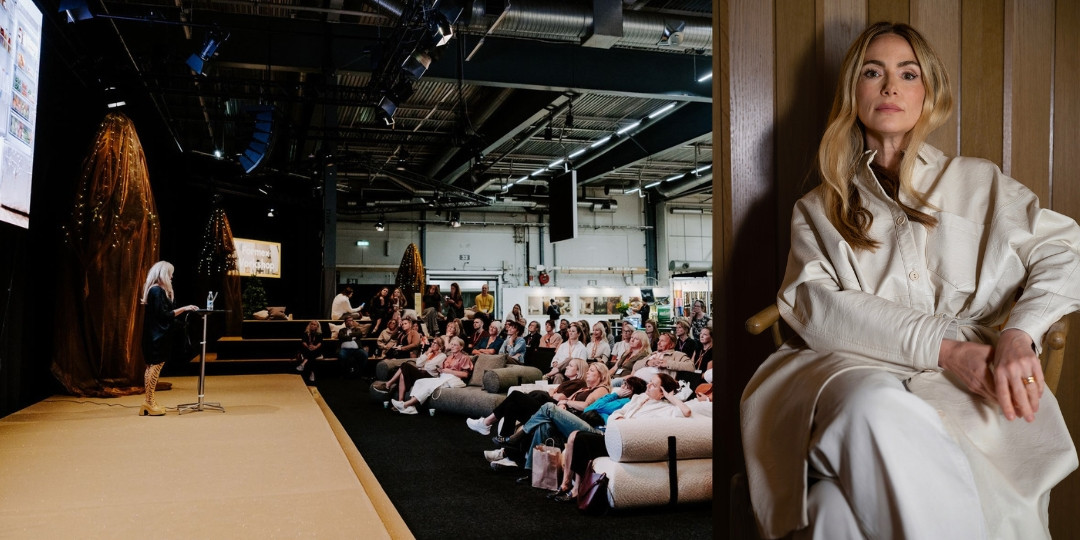
Phone-free café get-togethers, group dinners, and hand-painted films for major fashion houses. Ahead of Formex in January, Elin Frendberg explores why people are drawn to things they can do, experience, and share with others. We spoke with her about the work behind the trend report and what these changes might mean for you as a store owner, designer, or manufacturer.
What makes a customer stop, choose a product, and return to a store? For Formex, these are questions tied to an understanding of what people long for and how their everyday lives are changing. That’s why we’re collaborating for the second time with behavioral scientist and market analyst Elin Frendberg on the trade show’s trend reports.
Elin explores how technology, culture, and societal changes influence what we choose and spend our money on. She has worked with innovation within the H&M Group and led the Swedish Fashion Council and Fotografiska Stockholm. She has personally had to make decisions regarding the development of organizations, with responsibility for both the ideas and the finances.
The trend analysis takes shape over several months. Elin monitors developments, seeks out more examples, and updates the material right up until it goes to press. When the world is changing rapidly, the analysis needs to keep pace with current events, while also allowing time to assess which changes may have significance in the longer term.
What change do you think the industry should pay particular attention to as we head into January?
– We are now seeing a strong movement to reevaluate what makes us human. Human Intelligence (HI) is becoming an important counterpoint to AI. As the internet becomes increasingly populated by bots and mass-produced AI content, we’re also turning to the physical world and all it has to offer: relationships, love, and friendship; creativity and play; our hands, bodies, and minds. We are rediscovering what it means to have a body of flesh and blood.
– Just as the Arts and Crafts movement was a reaction against industrialization, we are now seeing a reaction to the development of AI. We’re leaving clear traces of humanity in the design that surrounds us. Handwritten text, visible fingerprints, and small-scale details are finding their way into even major brands.
– You can also see it in how they present themselves. Prada has worked with hand-drawn animation by John Pomeroy, Hermès with hand-sewn quilts in store windows, and Loewe with hand-painted watercolors in a film. The work itself becomes part of the story. The era of the hand is here.
You also see opportunities in the development of AI. What new ways of working and business activities do you think might emerge?
– We don’t yet know what the future of work will look like, but we can assume that new combinations, professions, and roles will emerge that we haven’t seen before. I am convinced that we will place greater value on roles that focus on human interaction and relationships. In the physical world, we can build trust and confidence, which are prerequisites for trade and business.
– Creativity and the creative process, as well as hospitality, will be valued more highly and professionalized. The same applies to the ability to select and tailor content and offerings in our physical and digital channels. Care, relationships, and practical skills will take on greater importance. Combinations of AI and human intelligence will become an important new arena.
– Good hospitality is as valuable as it is underappreciated today. In-person events and communities centered around a brand will be crucial for the brand to remain relevant. New types of experiences are emerging around people’s need for connection. Listening bars, which originated in Japan, can now be found from London to Hong Kong: spaces where people socialize and listen to vinyl together.
– The Offline Club began with a phone-free café gathering in Amsterdam in 2024. Group dinners, social sauna sessions, and clubs where participants learn something together are other examples. Interest in pottery, mahjong, crocheting, and baking also shows how people come together around activities that provide both a sense of community and something to do. Running clubs fulfill similar needs.
– This is the big playing field of the future. We’re ready for social interaction, to learn new things, and to use our bodies. Human needs, relationships, and creative expression are big business today.
What can you do with this knowledge?
A workshop at the store, a demonstration of a technique, or an evening centered around a shared interest. Elin’s examples offer several ideas to try based on the customers and business you already have. What do customers want to learn? What can you and your employees demonstrate or share? Is there a reason for customers to visit your store even between purchases?
At Formex, you can discuss your ideas with exhibitors and colleagues, explore materials, and find products that fit what you want to develop. Through the trend report, the exhibition, and Elin’s lectures, we want to provide you with both knowledge and inspiration to use when you get home.
Check out the analysis at Formex
Elin Frendberg’s trend report serves as the basis for an exhibition at the trade show and is also available as a printed brochure that visitors can pick up at select locations throughout the exhibition grounds. During the three days of the trade show, she will give one lecture per day in which she will present and expand on the report’s themes.
Formex will be held January 19–21, 2027, at Stockholmsmässan under the theme “More of You.”